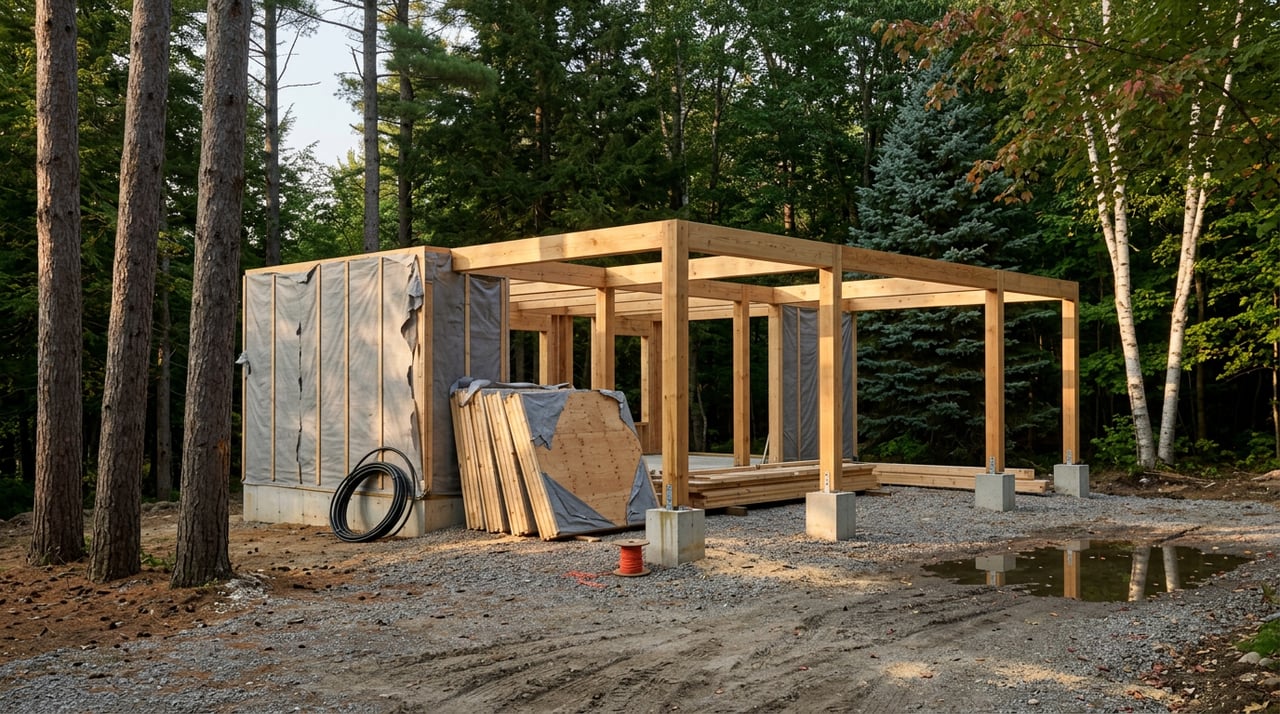
Drive past the corner of Swann Drive and Pioneer Drive this month and you will see a concrete slab, a paved lot with strange curved edges, and a timber frame that looks less like a nature center and more like a very large cabin. What you will not see, no matter how many times you circle the block, is the one detail that makes the whole site make sense. The parking lot is shaped like a loon. The solar canopy is shaped like a wing. You would need a drone, or a seat on a departing flight out of Brainerd, to notice either one.
Together, those details offer a look at what the National Loon Center is building in Crosslake. Separately, the timeline has shifted since the June 2025 groundbreaking.
A Building Designed to Be Seen From the Wrong Angle
The National Loon Center Foundation has been open about the concept from the start. The 10-acre campus includes a parking lot poured with a "bill" shape cut into it by paver stones, sidewalk markings meant to echo loon plumage, and a solar array angled to read as a wing from above. None of it is meant for the person standing at ground level. It is meant for the satellite image, the drone shot, the eventual aerial photo that shows up in a magazine or a fundraising brochure. The building's identity lives above the treeline, not at the curb.
The same logic runs underground. Fifty geothermal wells are being drilled beneath the site to heat and cool the building using the earth's constant subsurface temperature, a system designed to push the facility toward near net-zero energy use. As of this spring's construction updates, ten of the fifty wells were complete, with drilling continuing in phases alongside the start of the elevator shaft and the solar canopy foundations. Add in the cross-laminated timber and glulam beam structure that architect Ashley Martel of the Brainerd firm Widseth has highlighted as one of the project's defining features, and you get a building whose most ambitious engineering choices are the ones a passerby will never notice at all.
The Schedule Has Shifted
When the National Loon Center broke ground on June 20, 2025, at 3 p.m. on that same Swann Drive corner, the timeline on the table was a fall 2026 opening for a 15,000-square-foot facility. That was the number Brainerd Lakes Chamber President Matt Kilian and Executive Director Jon Mobeck were both working from at the ceremony, which coincided with Day One of the second annual Minnesota Loons & Lakes Festival.
The project has since grown, and the calendar has shifted.
| At groundbreaking (June 2025) | Current plan (2026) | |
|---|---|---|
| Building size | 15,000 square feet | 20,000 square feet |
| Target opening | Fall 2026 | Spring 2027 |
Those are the headline changes; the site's history adds another part of the story.
The Land Underneath the Story
The site itself has its own history worth knowing if you live nearby. The original plan placed the building on federal land managed by the U.S. Army Corps of Engineers at the Cross Lake Recreation Area, under a 25-year lease the Center had already finalized. That plan changed. The National Loon Center instead acquired the nearby 10-acre parcel at Swann and Pioneer, while keeping its programming and shoreline amenities at the original Cross Lake Recreation Area site, including a completed shoreline restoration project near the boat landing and a new floating dock system installed to prevent further erosion, with mooring stations available for campground guests and the public.
The land at Swann and Pioneer came from a longtime community member, Jim Anderson, who donated the property for the campus. Anderson passed away in October 2024, eight months before the groundbreaking he helped make possible. Speakers at the ceremony, including former state Sen. Carrie Ruud and Crosslake Mayor Jackson Purfeerst, made a point of naming him, along with the state funding secured through Sen. Foung Hawj's work and a $4 million allocation from Minnesota lawmakers that helped close the gap between private donations and the $18.5 million total.
Purfeerst put it simply at the ceremony: the project reflects who Crosslake is as a community, built on pride in the town and respect for the surrounding lakes.
You Do Not Have to Wait Until Spring
Here is the part most people driving past the construction site miss. Almost everything the finished building promises is already happening a few hundred yards away, in a much smaller space.
The Center's temporary visitor hub, called The Nest, has operated out of Crosslake Town Square since 2021 and has already introduced thousands of visitors to loon research through lake tours, trivia nights, and its Adopt-a-Loon program. From May through September, staff and volunteers run guided pontoon excursions aboard a boat nicknamed The StewardShip, offering respectful, up-close loon observation paired with conservation lessons on Cross Lake itself.
The rest of the year fills in around two named events worth putting on a calendar now:
- The Loons & Lakes Festival returned for its third year on June 26 and 27, 2026, with a Friday Lake Day built around guided loon-watching paddle excursions, a Pine River paddle, a guided bird walk with the Brainerd Audubon Society, a shoreline cleanup on the Whitefish Chain, and a late-night Loon Moon Paddle, followed by a Saturday Loon Fair at Crosslake Town Square with vendors, food trucks, and live music closing out the evening in the gazebo.
- The Loon Calling Contest returns as part of Crosslake Days on September 25 and 26, 2026, held at the Loon Center Nest site on Gould Street, with separate divisions for participants under and over 12.
None of this requires the finished campus. It requires showing up to a town square most Crosslake residents already pass through weekly.
Why the Location Was Never a Coincidence
The Minnesota DNR treats this stretch of lake country as a prime index area for loon monitoring, one of the strongest loon environments anywhere in the country, which is part of why a national research and education headquarters ended up on a corner lot in a town of a few thousand people rather than in a metro area. It also connects to something older than the construction timeline. The Whitefish Chain itself carries a name with deep roots, translated by 19th-century French astronomer Joseph Nicollet from the Native name Kadikumagokag, meaning Lake Where There Are Many Whitefish. A facility built to protect the call of the loon sitting a few miles from a chain whose name has always been about what lives in the water is not a marketing coincidence. It is the same relationship between land and water that has shaped this area for longer than anyone currently watching the concrete cure on Swann Drive has been alive.
The building will open in spring 2027, not fall 2026, and it will be about a third larger than the version announced at groundbreaking. The geothermal wells and the parking lot's aerial design are among the details that are easy to miss from a car window.
If watching Crosslake grow into something like this is part of why you love living here, Pederson Team would love to talk about what else is changing across the Whitefish Chain. Schedule a Lakeside Consultation whenever you are ready to talk about your own piece of this corner of Minnesota.